 → Speeches and works → Eulogy for Robert F. Kennedy


Edward M. Kennedy's eulogy for his brother, Robert F. Kennedy, on June 8, 1968, became a powerful reminder of Robert's dedication to justice, compassion, and public service. The speech helped solidify Robert's legacy as a champion of the underprivileged, inspiring future generations to continue his fight for equality and moral leadership in American politics.
The assassination of Senator Robert F. Kennedy occurred just days earlier on June 5 in Los Angeles. The country was already reeling from the assassination of Martin Luther King Jr. two months prior, and tensions over civil rights, the Vietnam War, and political unrest were high. Much of the U.S., was in mourning as thousands gathered at St. Patrick's Cathedral for Kennedy's funeral, while civil disorder and protests marked the broader social landscape of the era.
The audience at the eulogy expected a heartfelt tribute that would honor Robert F. Kennedy's life and legacy, while providing comfort amidst the national trauma of his assassination. As the youngest brother in the Kennedy family, Ted Kennedy was looked to for strength and composure in a moment of intense grief. The public, who admired Robert Kennedy for his commitment to social justice and his vision for America, anticipated a speech that would capture those ideals and offer hope. Many also expected Edward to echo the sense of loss and reflect on the political and social causes Robert had championed.
Ted Kennedy employed several key techniques in his eulogy for Robert Kennedy. He used quotes from Robert's own speeches, particularly from the 1966 South Africa address, to emphasize his brother's ideals. Parallelism was another powerful tool, repeating phrases to create rhythm and reinforce key messages of hope and moral courage. Personal anecdotes humanized Robert, showing him as both a public figure and a beloved family member. Kennedy also made use of emotional appeal to connect with the audience's grief, while ending on an optimistic note, urging action in the face of adversity.
The eulogy was widely regarded as a success in capturing the emotional gravity of the moment and honoring Robert Kennedy’s legacy. His ability to convey personal grief while emphasizing Robert’s ideals of justice and moral courage aligned with both the grieving family and the nation. By invoking Robert’s own words and calling for continued action in pursuit of his brother’s vision, Ted managed to offer solace and a sense of purpose to a public struggling with loss, thereby reinforcing the Kennedy family's enduring commitment to public service.
One key lesson from this speech is the importance of balancing emotional appeal with clear structure. The speaker skillfully used personal reflections, direct quotations, and repetition to create a speech that was both heartfelt and purposeful. By incorporating familiar phrases and shared values, he connected deeply with the audience while maintaining the focus on Robert Kennedy's legacy. Additionally, the use of a hopeful conclusion amidst tragedy is a powerful technique, helping to inspire action and resilience in listeners even in moments of sorrow.
Your Eminences, Your Excellencies, Mr. President:
On behalf of Mrs. Kennedy, her children, the parents and sisters of Robert Kennedy, I want to express what we feel to those who mourn with us today in this Cathedral and around the world.
We loved him as a brother, and as a father, and as a son. From his parents, and from his older brothers and sisters -- Joe and Kathleen and Jack -- he received an inspiration which he passed on to all of us. He gave us strength in time of trouble, wisdom in time of uncertainty, and sharing in time of happiness. He will always be by our side.
Love is not an easy feeling to put into words. Nor is loyalty, or trust, or joy. But he was all of these. He loved life completely and he lived it intensely.
A few years back, Robert Kennedy wrote some words about his own father which expresses the way we in his family felt about him. He said of what his father meant to him, and I quote:
"What it really all adds up to is love -- not love as it is described with such facility in popular magazines, but the kind of love that is affection and respect, order and encouragement, and support. Our awareness of this was an incalculable source of strength, and because real love is something unselfish and involves sacrifice and giving, we could not help but profit from it.
And he continued,
"Beneath it all, he has tried to engender a social conscience. There were wrongs which needed attention. There were people who were poor and needed help. And we have a responsibility to them and to this country. Through no virtues and accomplishments of our own, we have been fortunate enough to be born in the United States under the most comfortable conditions. We, therefore, have a responsibility to others who are less well off.
That is what Robert Kennedy was given. What he leaves to us is what he said, what he did, and what he stood for.
A speech he made to the young people of South Africa on their Day of Affirmation in 1966 sums it up the best, and I would like to read it now:
"There is discrimination in this world and slavery and slaughter and starvation. Governments repress their people; millions are trapped in poverty while the nation grows rich and wealth is lavished on armaments everywhere. These are differing evils, but they are the common works of man. They reflect the imperfection of human justice, the inadequacy of human compassion, our lack of sensibility towards the suffering of our fellows.
"But we can perhaps remember -- even if only for a time -- that those who live with us are our brothers; that they share with us the same short moment of life; that they seek -- as we do -- nothing but the chance to live out their lives in purpose and happiness, winning what satisfaction and fulfillment they can.
"Surely, this bond of common faith, this bond of common goal, can begin to teach us something. Surely, we can learn, at least, to look at those around us as fellow men. And surely we can begin to work a little harder to bind up the wounds among us and to become in our own hearts brothers and countrymen once again. The answer is to rely on youth -- not a time of life but a state of mind, a temper of the will, a quality of imagination, a predominance of courage over timidity, of the appetite for adventure over the love of ease.
"The cruelties and obstacles of this swiftly changing planet will not yield to the obsolete dogmas and outworn slogans. They cannot be moved by those who cling to a present that is already dying, who prefer the illusion of security to the excitement and danger that come with even the most peaceful progress.
"It is a revolutionary world we live in, and this generation at home and around the world has had thrust upon it a greater burden of responsibility than any generation that has ever lived. Some believe there is nothing one man or one woman can do against the enormous array of the world's ills.
"Yet many of the world's great movements, of thought and action, have flowed from the work of a single man. A young monk began the Protestant reformation; a young general extended an empire from Macedonia to the borders of the earth; a young woman reclaimed the territory of France; and it was a young Italian explorer who discovered the New World, and the 32 year-old Thomas Jefferson who proclaimed that 'all men are created equal'."
These men moved the world, and so can we all.
"Few will have the greatness to bend history itself, but each of us can work to change a small portion of events, and in the total of all those acts will be written the history of this generation. It is from numberless diverse acts of courage and belief that human history is shaped.
"Each time a man stands up for an ideal, or acts to improve the lot of others, or strikes out against injustice, he sends forth a tiny ripple of hope, and crossing each other from a million different centers of energy and daring, those ripples build a current that can sweep down the mightiest walls of oppression and resistance.
"Few are willing to brave the disapproval of their fellows, the censure of their colleagues, the wrath of their society. Moral courage is a rarer commodity than bravery in battle or great intelligence. Yet it is the one essential, vital quality for those who seek to change a world that yields most painfully to change. And I believe that in this generation those with the courage to enter the moral conflict will find themselves with companions in every corner of the globe.
"For the fortunate among us, there is the temptation to follow the easy and familiar paths of personal ambition and financial success so grandly spread before those who enjoy the privilege of education. But that is not the road history has marked out for us.
"Like it or not, we live in times of danger and uncertainty. But they are also more open to the creative energy of men than any other time in history. All of us will ultimately be judged, and as the years pass we will surely judge ourselves on the effort we have contributed to building a new world society and the extent to which our ideals and goals have shaped that event.
"The future does not belong to those who are content with today, apathetic toward common problems and their fellow man alike, timid and fearful in the face of new ideas and bold projects. Rather it will belong to those who can blend vision, reason and courage in a personal commitment to the ideals and great enterprises of American Society.
"Our future may lie beyond our vision, but it is not completely beyond our control. It is the shaping impulse of America that neither fate nor nature nor the irresistible tides of history, but the work of our own hands, matched to reason and principle, that will determine our destiny. There is pride in that, even arrogance, but there is also experience and truth. In any event, it is the only way we can live."
That is the way he lived. That is what he leaves us.
My brother need not be idealized, or enlarged in death beyond what he was in life; to be remembered simply as a good and decent man, who saw wrong and tried to right it, saw suffering and tried to heal it, saw war and tried to stop it.
Those of us who loved him and who take him to his rest today, pray that what he was to us and what he wished for others will some day come to pass for all the world.
As he said many times, in many parts of this nation, to those he touched and who sought to touch him:
"Some men see things as they are and say why. I dream things that never were and say why not."

 Edward M. Kennedy

 Robert Marion La Follette
 Nelson Mandela
 Bill Clinton
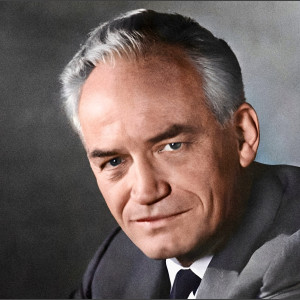 Barry Goldwater
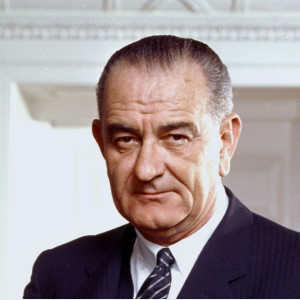 Lyndon Baines Johnson
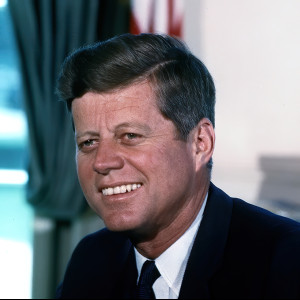 John F. Kennedy
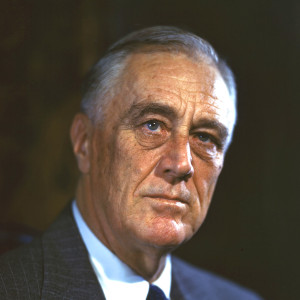 Franklin Delano Roosevelt
 Dwight D. Eisenhower
 Richard M. Nixon