 → Personalities → Franklin Delano Roosevelt


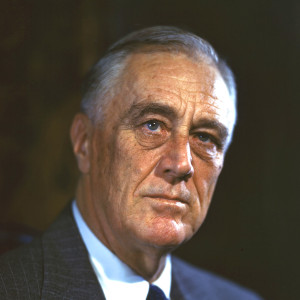
Franklin Delano Roosevelt was an important leader during two of the most critical periods in American history: the Great Depression and World War II. His ability to communicate directly with the public, particularly through his innovative use of "fireside chats," solidified his legacy as a president who profoundly impacted American society and governance.
Born on January 30, 1882, in Hyde Park, New York, and passing away on April 12, 1945, in Warm Springs, Georgia, he led the country through significant trials. Educated at Harvard and Columbia Law School, he initially pursued law before turning to politics, making a mark as a New York state senator and later as the Assistant Secretary of the Navy. Overcoming a personal battle with polio, he ascended to the governorship of New York, where he introduced progressive reforms. Elected president during the nadir of the Great Depression, his administration initiated the New Deal to address economic instability, subsequently guiding the nation through the tumult of World War II. He remains the only U.S. president elected to four terms, testament to his enduring influence and leadership during some of the most formative events of the 20th century.
During his presidency, he had a unique method for ensuring his speeches were concise and to the point. He used his dog, Fala, as a barometer for speech length. If during rehearsals his beloved Scottish Terrier lost interest or fell asleep, he took it as a sign that his speech needed to be shorter.
In 1921, at the age of 39, the future 32nd President of the United States was struck by a severe illness while vacationing at his summer home on Campobello Island. The illness resulted in permanent paralysis from the waist down, drastically altering his personal and professional life. Despite this significant challenge, his determination and resilience led to a remarkable political career, culminating in his election as President. His condition remained a closely guarded secret from much of the public throughout his presidency, with efforts made to avoid being seen in his wheelchair to maintain an image of physical strength.
FDR, as was known, played a pivotal role in shaping the modern American state through his response to the Great Depression and leadership during World War II. His implementation of the New Deal marked a significant expansion of government involvement in the economy, introducing a range of programs aimed at recovery, relief, and reform. This period saw the establishment of foundational social safety nets and regulatory frameworks that continue to influence the United States. Furthermore, his strategic guidance during the second World War not only contributed to the defeat of global fascism but also positioned the United States as a leading world power in the ensuing post-war era. His presidency is often viewed as a transformational period in American history, significantly impacting the nation's economic policies, social welfare systems, and international relations.
Franklin Delano Roosevelt was renowned for his exceptional communication skills, both as a speaker and a writer. His ability to connect with the American people was unmatched, particularly through his "fireside chats," which offered a sense of comfort and direct engagement during challenging times. These radio broadcasts showcased his skill in using simple, direct language to explain complex policies and reassure the public. His speeches and writings were characterized by a clear, persuasive style, often infused with optimism and an unwavering belief in American democracy. This combination of qualities made him a masterful orator and communicator, capable of inspiring confidence and hope in millions of Americans during the Great Depression and World War II.
One of the most pivotal and remembered speeches delivered by the 32nd President was his first inaugural address, where he famously declared, "the only thing we have to fear is fear itself." This speech not only showcased his exceptional oratory skills but also set the tone for his presidency, providing hope and reassurance to the American people during the depths of the Great Depression. Another significant speech was his address to Congress on December 8, 1941, following the attack on Pearl Harbor, in which he stated that date would "live in infamy," effectively galvanizing the United States to enter World War II. These speeches are often cited as some of his most impactful works, demonstrating his mastery in using rhetoric to inspire and lead the nation through times of crisis.
Franklin Delano Roosevelt's presidency marked a transformative era in American and global history, where his leadership and policies redefined the relationship between the government and its citizens, and reshaped international relations. His guidance during World War II not only led to a victory over tyranny but also helped lay the foundations for a new world order, emphasizing international cooperation and peace through the creation of the United Nations. His masterful communication, including his inspirational speeches and "fireside chats," offered hope and reassurance to a nation in despair, showcasing the power of empathy and direct engagement in leadership.
Studying Roosevelt's work highlights the importance of connecting with an audience on both an emotional and rational level, using clear and engaging language to convey powerful messages.
Studying his work offers valuable lessons in resilience, innovation, and strategic leadership during tumultuous times. His approach to overcoming personal and national challenges provides a blueprint for navigating adversity, emphasizing the importance of adaptability, perseverance, and the power of collective effort. Engaging with his speeches and policies not only enriches one's understanding of historical events but also imparts timeless wisdom on effecting positive change, leading with empathy, and the significance of visionary leadership. These lessons can be transformative, inspiring a deeper commitment to civic engagement, social responsibility, and the pursuit of common good in our own lives and communities.

 https://en.wikipedia.org/wiki/Franklin_D._Roosevelt