



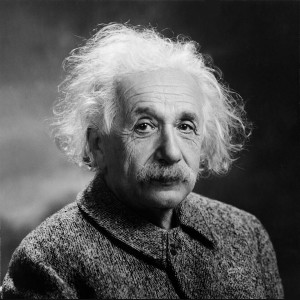
 → Personalities → Albert Einstein


Albert Einstein's most significant contribution to humanity is his development of the theory of relativity, encompassing both the special and general theories. This work fundamentally changed our understanding of space, time, and gravity, shifting the paradigm of physics beyond Newtonian mechanics. His equation E=mc², derived from these theories, articulated the equivalence of mass and energy, laying the groundwork for nuclear energy and advancing quantum mechanics. Einstein's ideas have had profound implications for scientific research, technology, and our conceptual grasp of the universe.
Born in the German Empire, this theoretical physicist revolutionized our understanding of the cosmos through his groundbreaking theories. Relocating to the United States amidst the rise of Nazism, his advocacy for peace and disarmament marked his later years. His profound contributions to quantum mechanics and the philosophy of science have made his intellect synonymous with genius, earning him global recognition and the title of the greatest physicist by many in the scientific community.
Despite his profound contributions to science, he was known for his forgetfulness with everyday items and appointments. This characteristic contrasted sharply with his extraordinary intellectual capabilities, illustrating a quirky human side to a figure often idealized for his scientific genius.
He experienced the painful rupture of his family when his first marriage ended in divorce, a period marked by personal turmoil and estrangement from his two sons. This reflects the challenges he faced beyond his scientific endeavors, underscoring the complexity of balancing personal relationships with a demanding career.
He was known for his ability to explain complex scientific ideas in a clear and engaging manner, making them accessible to a wide audience. His writings and lectures not only disseminated his revolutionary theories but also conveyed his deep philosophical insights, showcasing his eloquence and ability to connect with people beyond the academic sphere.
One of his most impactful contributions as a writer is the paper on the photoelectric effect, which not only earned him the Nobel Prize in Physics but also laid the groundwork for quantum mechanics. Additionally, his public lectures and essays, notably on the principles of relativity and the relationship between science and philosophy, keep been influential, demonstrating his exceptional ability to articulate complex scientific ideas and philosophical viewpoints in a way that resonates with both the scientific community and the general public.
He passionately advocated for peace and expressed grave concerns about the potential consequences of nuclear weapons. In a notable letter to a prominent leader, he warned of the dangers posed by atomic energy in warfare, urging for the establishment of international control over nuclear weapons. His speeches and writings emphasized the importance of responsibility and ethical considerations in scientific advancements, reflecting his deep commitment to using science for the betterment of humanity rather than its destruction.
Albert Einstein's contributions to humanity extend beyond his scientific achievements, encompassing his advocacy for peace and ethical responsibility in the face of nuclear proliferation. His groundbreaking theories reshaped our understanding of the universe, while his warnings about the dangers of atomic weapons highlighted the moral implications of scientific advancements. His ability to convey complex ideas with clarity and engage in critical societal issues underscores his lasting importance to humanity, blending profound intellectual insight with a deep concern for the future of mankind.
Through Einstein’s examples, we learn that effective writing and speaking require not only a deep understanding of the subject matter but also a genuine effort to connect with the audience by making complex ideas comprehensible and engaging.
Exploring the works and ethical perspectives of this influential figure in science enriches personal understanding of our world, fostering a sense of curiosity and responsibility. It encourages us to think critically about the impact of scientific discoveries on society and the importance of using knowledge to contribute positively to the world, nurturing a well-rounded, informed worldview.

 https://en.wikipedia.org/wiki/Albert_Einstein



 Robert Marion La Follette