



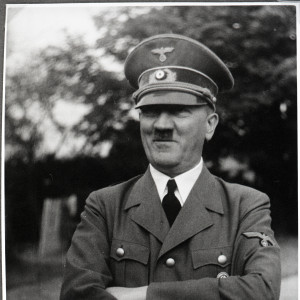
 → Personalities → Adolf Hitler


Adolf Hitler initiated the conflict thet resulted in profound global consequences. As the Führer of Nazi Germany from 1933 to 1945, he implemented policies leading to the Holocaust, where six million Jews and millions of others were murdered. His aggressive expansionist policies led to the devastation of World War II, causing the deaths of tens of millions of people and changing the geopolitical landscape of the world.
Hitler was born in Austria in 1889 and rose to prominence in Germany following World War I, becoming the leader of the National Socialist German Workers' Party. His ascent to the chancellorship in 1933 marked the beginning of a totalitarian regime characterized by its aggressive expansionist policies and the initiation of World War II.
Hitler was twice rejected by the Academy of Fine Arts Vienna in 1907 and 1908, a setback that significantly impacted his early aspirations in the arts. This rejection redirected his path significantly, leading him away from a potential career as an artist. He also had a unique relationship with his pet dog, Blondi, gifted to him in 1941, showing a softer side amidst his notorious rule.
His leadership reshaped the political and social landscape of the 20th century, leaving a lasting impact on world history, serving as a stark reminder of the dangers of totalitarianism, racism, hate, and the consequences of unchecked power.
He was known for his compelling public speaking skills, which played a crucial role in his rise to power. His ability to captivate and mobilize masses with his speeches, alongside his written works, notably "Mein Kampf," showcased his persuasive use of language to propagate his ideology.
His most influential work as a writer is "Mein Kampf," a manifesto written during his imprisonment in 1924, which outlines his ideology and future plans for Germany. As a speaker, his abilities to communicate and rally support were pivotal in his rise to power, utilizing mass gatherings and radio broadcasts to disseminate his vision and mobilize the German population.
Studying the works of such historical figure offers insights into how rhetoric and propaganda can be used to mobilize a nation, teaching critical lessons on the impacts of authoritarianism and the importance of safeguarding democratic values. Such an examination not only helps in comprehending the past but also in preventing the repetition of historical atrocities.
It equips us with the knowledge to critically assess the implications of leadership and propaganda, fostering a more informed and vigilant society capable of recognizing and countering authoritarian tendencies. This understanding is essential for promoting peace, democracy, and human rights, ensuring that the lessons of history are learned and not repeated.

 https://en.wikipedia.org/wiki/Adolf_Hitler
 Robert Marion La Follette