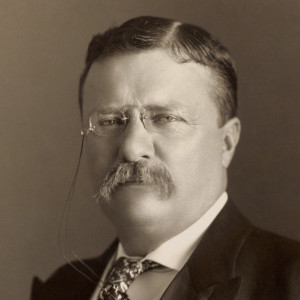
 → Personalities → Theodore Roosevelt


Theodore Roosevelt transformed the American presidency by expanding the role and power of the federal government in economic and social issues. His "Square Deal" policies aimed at ensuring fairness for workers, businesses, and consumers. Roosevelt was a staunch advocate for anti-trust laws, famously breaking up major monopolies to promote competition and protect consumers. Moreover, his vigorous foreign policy, encapsulated by the motto "speak softly and carry a big stick", positioned the United States as a formidable global power. Finally, his dedication to conservation established numerous national parks and forests, which safeguarded America's natural heritage for future generations.
Born in 1858 into a wealthy family in New York City, he overcame childhood illnesses through determination and a vigorous lifestyle. His early career included roles such as a New York State Assemblyman, Police Commissioner of New York City, and Assistant Secretary of the Navy. He gained national fame as a leader of the Rough Riders during the Spanish-American War. Ascending to the presidency in 1901, he implemented progressive reforms and expanded American influence abroad. After his presidency, he continued to influence politics and public discourse until his death in 1919 at his home in Oyster Bay, New York.
Known for his adventurous spirit, he had a deep passion for hunting exotic animals. This interest took him on a famous expedition to Africa in 1909-1910, shortly after leaving the presidency. The journey, sponsored by the Smithsonian Institution, involved extensive hunting and collecting specimens for scientific study. During the expedition, he and his party hunted and preserved thousands of animals, including lions, elephants, and rhinoceroses, contributing significantly to the natural history collections of American museums.
In 1884, he had a profound personal loss when his mother and his first wife both died on the same day, just hours apart. This double tragedy led him to retreat to the Badlands of North Dakota, where he immersed himself in ranching and the rugged outdoor life to cope with his grief.
As president, he played a crucial role in expanding the federal government's ability to regulate business practices and protect public welfare. He vigorously enforced antitrust laws to dismantle monopolies, including the landmark case against John D. Rockefeller`s Standard Oil, which resulted in its breakup in 1911. His "Square Deal" policies also addressed labor disputes, such as the 1902 coal strike, ensuring fair treatment for workers. Furthermore, he significantly advanced conservation efforts, establishing numerous national parks, forests, and wildlife refuges, and enacting the National Reclamation Act to manage natural resources and promote sustainable development.
Renowned for his eloquence and vigor, he was a compelling speaker and prolific writer. His speeches were marked by their powerful delivery and persuasive rhetoric, often infused with his boundless energy and confidence. As a writer, he produced a vast array of works, including autobiographies, histories, and essays, demonstrating a clear and engaging style. His ability to communicate effectively through both spoken and written word inspired public support for his progressive policies.
Among his most notable works as a writer is "The Rough Riders", a firsthand account of his experiences leading the volunteer cavalry regiment during the Spanish-American War. This book showcases his vivid storytelling and deep patriotism. He also penned "The Winning of the West", a multi-volume series detailing the expansion of the American frontier, highlighting his scholarly approach to history and his appreciation for the American spirit.
As a speaker, one of his most famous speeches is the "Man in the Arena", also known as "Citizenship in a Republic", from his 1910 address at the Sorbonne in Paris. This speech emphasizes the importance of active participation in public life and has inspired countless individuals with its powerful message about perseverance and effort.
He played a transformative role in shaping the modern American presidency through progressive reforms, trust-busting, and conservation efforts. His decisive actions against monopolies and cartels promoted fair competition and economic justice. His "Square Deal" policies mediated labor disputes and advanced workers` rights, while his passion for conservation led to the creation of numerous national parks and forests. His writings and speeches continue to inspire us with their vigor and patriotic spirit.
From his works, we can learn the power of vivid, direct language in both writing and public speaking. His ability to tell compelling stories, as seen in his account of the Rough Riders, underscores the importance of personal experience and authenticity in engaging an audience. His speeches demonstrate how passionate delivery and clear, persuasive rhetoric can mobilize public support and drive change. Additionally, his extensive writings reflect meticulous research and a deep understanding of his subjects, illustrating the value of thorough preparation and knowledge in effective communication.
Studying his work offers valuable insights into leadership, resilience, and effective communication. His writings demonstrate the impact of clear, engaging storytelling, while his speeches highlight the power of conviction and persuasive rhetoric. By examining his approaches, one can learn the importance of perseverance, the necessity of thorough preparation, and the ability to inspire and mobilize others towards meaningful change.

 https://en.wikipedia.org/wiki/Theodore_Roosevelt