 → Personalities → Daniel Webster


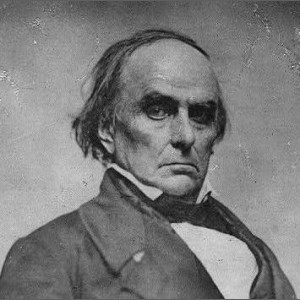
As one of the nation's greatest orators, Daniel Webster articulated the principle of federal supremacy over states' rights, most notably in his "Second Reply to Hayne" in 1830, where he famously declared, "Liberty and Union, now and forever, one and inseparable!" This speech, along with his efforts in the U.S. Senate and as Secretary of State, helped shape the legal and political framework of the United States, emphasizing the importance of a unified nation. His work laid the groundwork for the ongoing debate over the balance of power between the federal government and the states, a central theme in American democracy.
Born in New Hampshire in 1782, this influential American figure emerged from humble beginnings to become one of the most prominent lawyers and statesmen of the early 19th century. Educated at Dartmouth College, he initially practiced law in New Hampshire before relocating to Boston, where his legal prowess gained national attention. His career in public service was distinguished by terms in both the House of Representatives and the Senate, where he was a vocal advocate for national unity and the supremacy of federal law. He twice held the position of Secretary of State, negotiating significant treaties that played a pivotal role in defining the nation's borders and diplomatic relations. His enduring legacy is marked by his contributions to the American legal system and his unwavering dedication to the principles of the Constitution and the Union.
Despite his successful legal and political career, he was notoriously poor at managing his money, often finding himself in debt. His financial struggles were well-known among his contemporaries, leading him to rely on the generosity of friends and supporters to bail him out. This juxtaposition of his profound professional accomplishments and his personal financial mismanagement highlights a fascinating contradiction in his character, showcasing that even the most influential figures can have everyday challenges.
One of the most critical roles played by this eminent figure in American history was his defense of the Constitution and his efforts to preserve the Union during a time of growing sectional tension. His unparalleled oratory skills were most notably displayed in a series of debates where he argued fervently against the concept of states' rights to nullify federal law, thereby championing the idea of a strong, centralized national government. His contributions were not limited to his speeches; as Secretary of State, he also negotiated significant treaties that had lasting impacts on the nation's territorial and diplomatic landscape. Through these actions, he left an indelible mark on the United States, shaping its legal and political framework in ways that still resonate today.
In the twilight of his illustrious career, the distinguished statesman's final bid for the presidency in 1852 ended in disappointment, as he failed to secure the nomination from his party. This unfulfilled ambition marked a somber conclusion to a life devoted to public service and the principles of the Union. Just months after this political setback, he passed away, leaving behind a legacy as one of America's most influential figures without having achieved the office he most aspired to.
This illustrious American figure was celebrated for his exceptional oratory and eloquence, possessing a commanding presence that could captivate any audience. His speeches were marked by their clarity, forcefulness, and profound use of language, enabling him to convey complex legal and constitutional arguments with persuasive power. As a writer, he demonstrated a keen intellect and a deep understanding of the nation's founding principles, crafting texts that have endured as models of legal and political discourse.
Among the most significant contributions of this distinguished American statesman were his powerful speeches, which left a lasting impact on the nation's political landscape. One of his most renowned orations, the "Second Reply to Hayne," delivered in the Senate in 1830, stands out for its eloquent defense of the Constitution and the Union. In this speech, he famously countered arguments for states' rights and nullification with a passionate appeal for national unity, coining the immortal phrase, "Liberty and Union, now and forever, one and inseparable!" This speech not only showcased his exceptional skill as an orator but also solidified his position as a central figure in the debates that shaped the course of American democracy.
As a writer, his contributions were equally impactful, with numerous legal briefs, diplomatic correspondences, and public letters that articulated his views on governance, law, and foreign policy. His written work, characterized by its persuasive rhetoric and clarity of thought, helped to influence public opinion and guide the nation through periods of challenge and change. Through both his spoken and written words, he played a crucial role in defining the principles upon which the United States was to navigate its future, leaving an indelible mark on American history.
Through his exceptional oratorical and literary contributions, he championed the cause of a united nation, steadfastly opposing any forces that threatened its integrity. His legacy, therefore, extends beyond his immediate impact on American law and politics to his enduring influence on the ideals of democracy and national cohesion, principles that continue to inspire and guide societies around the world.
Webster's works teach us the importance of understanding the audience, using persuasive language, and structuring arguments logically and emotionally. His dedication to the Union and his ability to adapt his message to the evolving political landscape also highlight the importance of flexibility and relevance in both writing and speaking.
Studying the work of Daniel Webster can profoundly enrich our understanding of democratic values, the importance of eloquent communication, and the role of law in shaping society. His commitment to unity and the principles of the Constitution provides timeless lessons on the importance of collective responsibility and the power of well-reasoned discourse in resolving conflicts and advancing the common good. Engaging with his legacy offers not only a deeper appreciation for the complexities of history and governance but also inspires a more informed and active participation in the democratic process, underscoring the impact that persuasive speech and principled leadership can have on the world.

 https://en.wikipedia.org/wiki/Daniel_Webster