



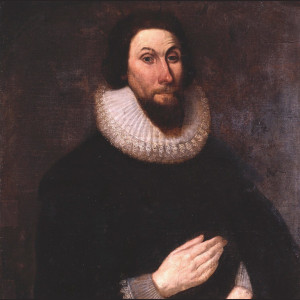
 Italiano; Jan Winthrop
 Nederlands; Jean Winthrop
 Français; João Winthrop
 Português; Johann Winthrop
 Deutsch; Juan Winthrop
 Español; Ιωάννης Γουίνθροπ (Ioannis Gouínthrop)
 Ελληνικά; Джон Уинтроп (Dzhon Uintrop)
 Русский; جون وينثروب (Jun Waynthrub)
 العربية; ジョン・ウィンスロップ (Jon Winsuroppu)
 日本語; 约翰·温斯罗普 (Yuēhàn Wēnsīluòpǔ)
 汉语; 존 윈스로프 (Jon Winseuropeu)
 한국어
 → Personalities → John Winthrop


Winthrop became famous for leading the first large wave of Puritan settlers to New England and establishing the Massachusetts Bay Colony in 1630. As the colony's first governor, he played a critical role in shaping its governance, social structure, and religious ethos. His vision for the colony highlighted his belief that the new settlement should serve as a model of Christian virtue and communal harmony, influencing the development of American cultural and religious identity.
Born in 1588 in England, this future colonial leader studied at Trinity College and later at Gray's Inn. His early life involved significant engagement with theological discussions, which deeply influenced his Puritan beliefs. By 1605, he married Mary Forth and later assumed the role of lord of the manor at Groton. Fleeing religious persecution, he helped obtain a royal charter for the Massachusetts Bay Company and led a large group of Puritans to New England in 1630. Over his lifetime, he governed the Massachusetts Bay Colony for 12 of its first 20 years, shaping its religious and social frameworks until his death in 1649 in Boston.
A curious fact about the first governor of the Massachusetts Bay Colony involves his candid diary entries from his youth. In these entries, he openly confessed to struggling with "lusts...so masterly as no good could fasten upon me," reflecting his youthful struggles and attempts to reform his behavior through religious devotion. This personal glimpse into his life offers an unusual contrast to his later reputation as a stern and pious leader of the Puritans.
John experienced significant personal loss during his life. His first wife, Mary Forth, bore him five children, but only three survived to adulthood. She died in 1615 due to complications from childbirth, and just over a year later, his second wife, Thomasine Clopton, also died shortly after giving birth. Despite these tragedies, he insisted in getting married, eventually wedding Margaret Tyndal, with whom he shared a more stable and enduring relationship.
He was instrumental in organizing the migration of Puritans to New England, leading the initial fleet of ships, and delivering the famous "City upon a Hill" frase, which articulated his vision of a model Christian society. His governance included creating a stable political structure, fostering community cohesion, and navigating conflicts with Native Americans and dissidents like Roger Williams and Anne Hutchinson. His actions, such as negotiating with local tribes and enforcing Puritan religious conformity, were foundational in shaping the early social and political landscape of New England.
Renowned for his eloquence and persuasive skills, John was a powerful orator and writer. His most famous work, the "A Model of Christian Charity" sermon, where he mentions the "City upon a Hill", exemplifies his ability to inspire and unify his audience with a vision of communal responsibility and moral duty. His writings, including detailed journals and letters, showcase his deep theological knowledge, reflective nature, and commitment to the Puritan cause, making him a compelling and influential figure in early American history.
His sermon "A Model of Christian Charity," delivered in 1630 aboard the Arbella, outlined his vision for the new colony, emphasizing the importance of communal solidarity, justice, and mercy among the settlers. He famously described the colony as a "city upon a hill," a phrase that has endured as a symbol of American exceptionalism and the idea that the community should serve as a moral example to the world.
Another important work is his personal journal. This detailed record spans from 1630 to 1649 and provides a comprehensive account of the early years of the Massachusetts Bay Colony, including its political, social, and religious developments. His writings in the journal offer valuable insights into the daily life and challenges faced by the settlers, as well as his personal reflections and theological musings.
John Winthrop leadership established the Massachusetts Bay Colony and shaped its religious and social frameworks. His vision of a harmonious and morally upright community influenced American ideals of exceptionalism and collective responsibility. His governance provided a foundation for the political and social development of New England, impacting the cultural and religious landscape of early America.
Through the detailed sermons and reflective journal entries of the first governor of the Massachusetts Bay Colony, we learn that effective text writing and public speaking require a clear articulation of vision and purpose. His ability to weave together religious principles with practical guidance for communal living demonstrates the importance of integrating ethos and pathos to inspire and unify an audience. His writings exemplify clarity, structure, and the use of rhetorical devices to reinforce his messages. Furthermore, his emphasis on moral and ethical conduct underscores the role of a speaker or writer in guiding and shaping the values of their audience.
Studying his work offers valuable insights into leadership, ethical governance, and community building. His emphasis on moral integrity, communal responsibility, and vision in his writings can inspire us to cultivate similar values in our personal and professional lives. His works teach the importance of clear communication, purposeful action, and the impact of collective effort in achieving significant goals.

 https://en.wikipedia.org/wiki/John_Winthrop